
Things to See in Chatham MA
Chatham, Massachusetts sits at the elbow of Cape Cod, where land curves and meets the open Atlantic on three sides. The town's natural geography shapes everything here. Fishing piers, a centuries-old lighthouse, protected wildlife refuges, and quiet conservation trails give visitors a genuine sense of place that few Cape Cod towns can match.
Whether you spend a morning watching boats unload their catch at the waterfront or an afternoon walking a salt marsh trail, Chatham rewards every kind of visitor. The landmarks here are not replicas or tourist constructions. They are working, living parts of the town's daily life.
Chatham Fish Pier
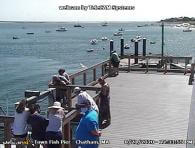
The Chatham Fish Pier sits at the corner of Shore Road and Barcliff Avenue, on Aunt Lydia's Cove at 54 Barcliff Road Extension. It is Cape Cod's largest commercial fishing pier and the single most-visited public attraction in Chatham.
The fishing fleet heads out each suitable day to grounds ranging from 3 to 100 miles offshore. The catch includes haddock, cod, flounder, lobster, pollock, dogfish, and halibut. Boats typically start returning after noon, depending on the tide. Fresh catch goes into ice and leaves in refrigerated trucks for Boston, New York, New Bedford, and local markets within 24 hours of leaving the ocean.
The pier was built by the town in 1946. Before it existed, fishermen relied on scattered docks around Oyster Pond, Stage Harbor, and the Old Harbor. The pier centralized the industry and transformed how quickly fresh fish reached markets.
At the old Fulton Fish Market in New York, the finest fish, regardless of origin, were simply called "chathams." Today, the fleet brings in more than 25 million pounds of seafood per year, destined for local, national, and international markets.
From the public observation deck, visitors can watch crews offload catch directly from the boats. Harbor seals often appear near the pier when boats are unloading. Parking in the upper lot is open to visitors. The lower lot is by permit only.
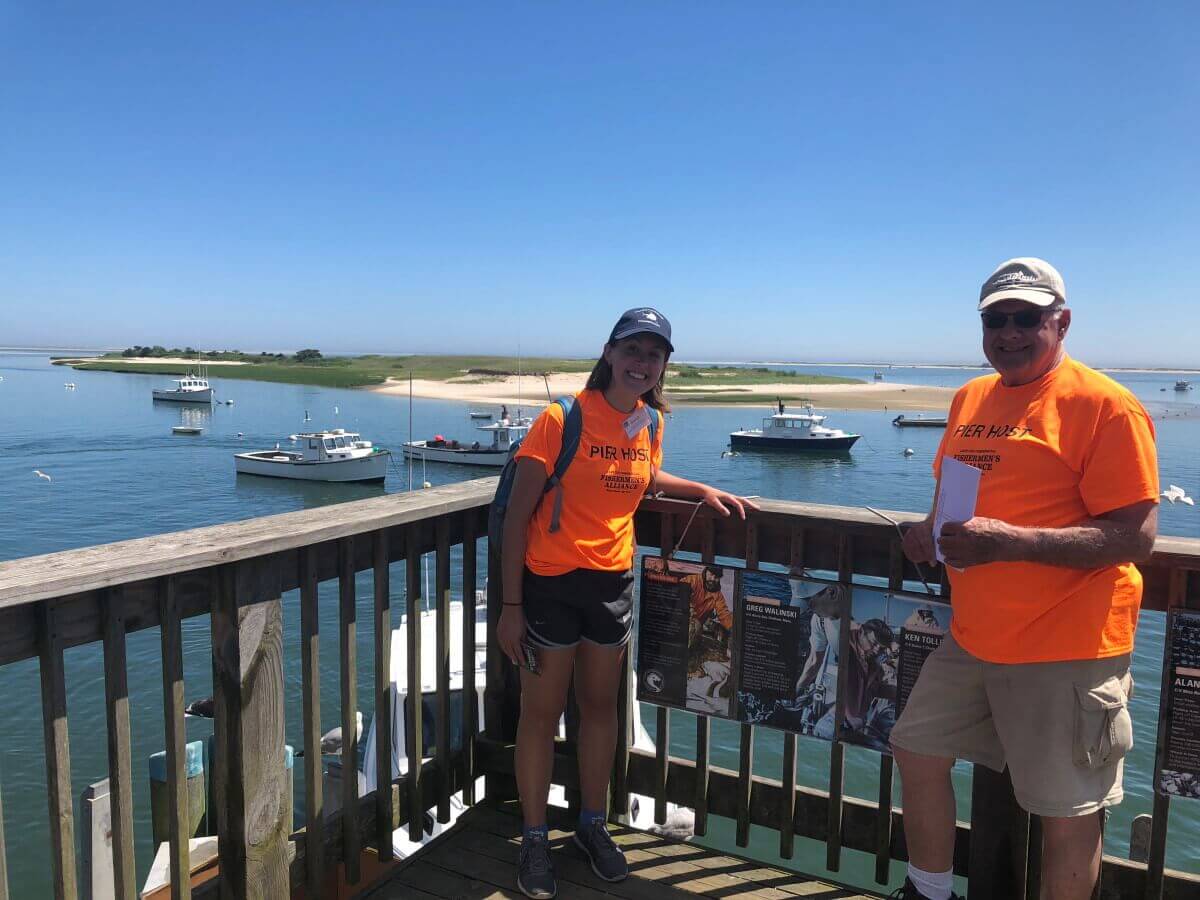
On select days throughout the season, the Cape Cod Commercial Hook Fishermen's Association (CCHFA) runs a Pier Host Program at the Fish Pier. Experienced fishermen guide visitors through the history of the industry, explain sustainable fishing methods, and show guests what a working day on the water looks like. It is one of the best free educational programs on Cape Cod.
Learn about the maritime history of Chatham while having a fisherman show you the ropes at the Chatham Fish Pier. On select days, there will be a Pier Host available to tell visitors about an industry that is vital to the Cape’s past, present, and future. For a schedule, please visit: http://www.capecodfishermen.org/pier-program
Fisherman's Monument
Standing at the pier is "The Provider," a bronze sculpture dedicated in June 1992. The monument shows a strong hand pulling a fishing net from the sea, with fish and shellfish native to Chatham waters caught in the net. The motto cast on the base reads "ever changing to remain the same."
The piece was selected through an international competition that drew around 100 entries. Sculptor Sig Purwin of Woods Hole won after the Chatham fishing community voted among three finalists.
The monument was funded and organized by a local committee formed specifically to recognize the fishing industry's role in Chatham's identity. It was designed to honor not just those who fished in the past, but those still working the water today.
Cape Cod Commercial Hook Fishermen's Association (CCHFA) Pier Host Program
Our residents and summer visitors have long been known of the delightful physical characteristics of Chatham, such as the beaches, marsh and wetlands, and meadows. Preservation of these resources is a benefit to our economy, our fisheries, wildlife, and flora, a fact now recognized to a greater extent in the past few years by Federal, State, and Local authorities.
Chatham is fortunate in having in addition to the Town Conservation Commission, a privately operated organization in the Chatham Conservation Foundation, Inc., (540 Main Street, Chatham, MA 02633), dedicated to the preservation of these valued areas. The Foundation, chartered in 1962, is in the hands of five year-round residents, as Trustees, Officers, and Executive Committee, without salary.
Many gifts of wetlands and marshlands have been donated to this organization, and others have been obtained by purchase. To date, more than 540 acres have been put into conservation so our residents and visitors may enjoy them. Walking trails are maintained in four areas. Please refer to the map on pages 12-13 for the starting points of the four trails described below.
A highlight of the Foundation's work in the field of education is their second publication, "A Beachcomber's Botany", 158 pages with 113 illustrations by Marcia Gaylord Norman, and text by Loren C. Petry, Professor Emeritus, Cornell University. It is a valuable guide to the interesting plant life in the marshes, along the shore, and in the upland. Copies are available at a nominal cost directly from the Foundation Headquarters (see Mayo House), across from the Information Booth, or at several bookstores and gift shops. Trail Guide
Chatham Lighthouse
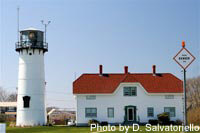
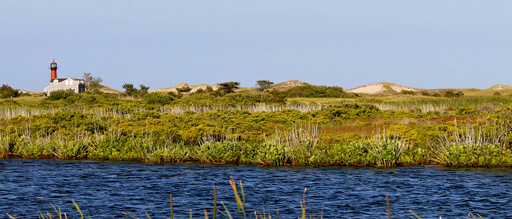
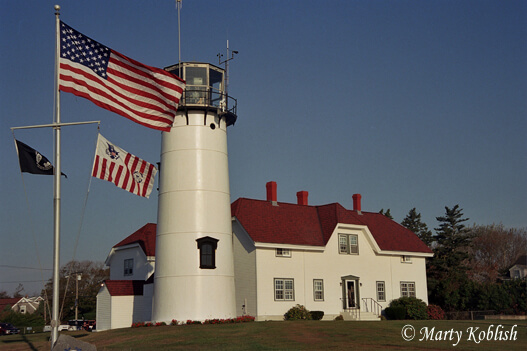
Chatham Lighthouse stands at 37 Main Street on a bluff overlooking the Atlantic, Chatham Bar, and North Beach. It is the town's most recognized landmark, and one of the most visited spots on Cape Cod. Learn the full history of this iconic structure in our deep-dive guide to Chatham Lighthouse.
The station was established in 1808 as the second lighthouse built on Cape Cod, after Highland Light in Truro. To distinguish it from Highland Light when seen from sea, two towers were placed 70 feet apart on movable skids. Mariners knew the station for years as "Twin Lights." The first keeper, Samuel Nye, was appointed by President Thomas Jefferson on October 7, 1808.
Erosion drove major changes over the following decades. A severe storm in November 1870 accelerated cliff loss. By 1877 the towers stood only 48 feet from the bluff edge. Two new 48-foot cast-iron towers were built that year, relocated across the road to safer ground. In 1923, one of the twin towers was moved to Eastham, where it became Nauset Light.
The lighthouse was added to the National Register of Historic Places in 1987. Today it operates as part of an active U.S. Coast Guard station. The beacon produces 2.8 million candlepower and is visible 24 nautical miles out to sea. It flashes twice every 10 seconds and has operated continuously, 24 hours a day, for generations.
The U.S. Coast Guard Auxiliary, Flotilla 11-1, leads free public tours of the lighthouse on Wednesdays from 1 PM to 3:30 PM during the summer season and at First Night. Visitors climb 44 steps to the lantern room for panoramic views of the coastline. The original Fresnel lens, removed in 1969, is now on display at the Atwood House Museum.
Public telescopes near the overlook provide close views of the famous North Beach Breakthrough, where the sea carved an opening through the barrier beach. Check the Events Calendar for current tour schedules and special access dates throughout the year.
Conservation Trails
The Chatham Conservation Foundation has preserved more than 540 acres of wetlands, marshes, and upland habitat since its founding in 1962. All four of its walking trails are free, open to the public year-round, and offer a quiet contrast to Chatham's busier summer spots. Dogs are permitted on all four trails but must remain on a short leash.
Frost Fish Creek Trail
This 1-mile loop begins off Orleans Road (Route 28) in North Chatham. It passes through creek, marsh, woodland, and open fields. Allow 45 minutes to an hour. Parking is limited at the trailhead.
Barclay Ponds Trail
The Barclay Ponds Trail runs along Old Queen Anne Road and Training Field Road through quiet woodland with mild hills. The distance is approximately 1.5 miles, taking 45 minutes to an hour. Parking is available at the trailhead.
Mill Pond Overlook
Located on Stage Harbor Road next to the Atwood House Museum, this 0.5-mile trail takes about 30 minutes round trip. The surface is woodchip and soil with mild grades. Native plant restoration is ongoing along the route. Park at Oyster Pond Beach.
Morris Island Trail
The Morris Island Trail runs through beach, forest, dunes, salt marsh, and tidal flats inside the Monomoy National Wildlife Refuge. It is 1.5 miles long and takes 45 minutes to an hour. This trail is open every day of the year from half an hour before sunrise to half an hour after sunset.
It is among the best birdwatching trails on Cape Cod. Piping plovers, roseate terns, and red knots are regularly spotted here during migration. Dogs are only permitted on a short leash between September 16 and April 30, in order to protect nesting birds during breeding season. The parking area is at the refuge Visitor Center on Wikis Way.
The Chatham Conservation Foundation also publishes a Trail Guide with detailed maps of all four routes. Their illustrated field reference, "A Beachcomber's Botany," is available for purchase at their headquarters at 540 Main Street and at several local bookstores.
Monomoy National Wildlife Refuge
Monomoy National Wildlife Refuge covers 7,604 acres of ocean, dunes, salt and freshwater marshes, and freshwater ponds stretching south from Chatham.
It was established in 1944 as a sanctuary for migratory birds and is now one of the most ecologically significant wildlife areas on the entire East Coast. For a full guide to birdwatching and seasonal access, see our Monomoy National Wildlife Refuge guide.
The refuge spans three barrier islands: North Monomoy, South Monomoy, and Minimoy Island, plus the Morris Island mainland unit. In 1970, half the refuge's acreage was designated a Wilderness Area under the Wilderness Act of 1964. It is the only federally designated wilderness in southern New England.
Monomoy is a critical link in the Atlantic Flyway chain of migratory waterfowl refuges. It provides resting, nesting, and feeding habitat for more than 285 recorded bird species and over 40 shorebird species. The site hosts one of the largest nesting colonies of common terns on the Atlantic seaboard, exceeding 13,000 nesting pairs.
Federally protected species found here include the piping plover, roseate tern, and red knot. Monomoy's beaches also host some of the highest concentrations of nesting piping plovers in all of New England.
Beyond birds, the refuge supports gray seals, horseshoe crabs, and the endangered northeastern beach tiger beetle. The U.S. The Fish and Wildlife Service has successfully reintroduced the beetle on South Monomoy Island, collecting larvae to help restore populations on other beaches.
The refuge holds three major conservation designations: Important Bird Area for Massachusetts, Western Hemisphere Shorebird Reserve Network Regional Site, and Marine Protected Area.
The Refuge Visitor Center is at 30 Wikis Way in Chatham. Friends of Monomoy volunteers staff an information kiosk there daily from 10 AM to 4 PM between Memorial Day and Labor Day. The Morris Island Loop Trail is accessible year-round from sunrise to sunset. Surf fishing on Morris Island is permitted 24 hours a day.
To drive to the refuge from Route 6, take Route 137 south to Route 28, then left through downtown Chatham. Turn right at the stop sign toward the lighthouse, take the first left after the lighthouse, then the first right. Follow signs to Wikis Way.
To visit the offshore islands, you will need a personal watercraft or boat. Seasonal bird protection closures apply on the islands, so check the public use map on the FWS website before landing.
Wheeled carts are not permitted within the Monomoy Wilderness. Dogs are not allowed on any offshore islands. An interactive map showing how the refuge's barrier islands have shifted over the past century is available on the refuge's story map linked from fws.gov.
Samuel de Champlain 1606 Voyage Commemoration Monument
A monument on Champlain Road marks the location where French cartographer Samuel de Champlain landed in 1606. Champlain spent two weeks in what is now Chatham before tensions with the native Wampanoag escalated.
A skirmish ended the visit, leaving four French sailors and a larger number of Monomoyick people dead. The Monomoyicks were the Wampanoag band living directly in this area.
The monument acknowledges a complicated chapter in Chatham's pre-colonial history. It recognizes both the arrival of one of North America's most significant explorers and the violent encounter that ended his stay. Champlain went on to map much of the northeastern coastline and played a foundational role in early French colonization of the continent.
Parks and Playgrounds
Chatham's public parks and playgrounds serve residents and visitors throughout the year. They sit close to the town center and offer an easy complement to a day of sightseeing.
Kate Gould Park
Kate Gould Park sits near the center of town and becomes the heart of Chatham's summer social life on Friday evenings. The Chatham Band performs there every Friday in July and August, drawing crowds of up to 6,000 people. These free outdoor concerts have been a Cape Cod institution for decades and remain one of the most attended recurring events on the Lower Cape.
Chase Park and William Nickerson Memorial Park
Chase Park on Cross Street adjoins the historic Grist Mill and includes a bowling green and picnic tables. Nearby is William Nickerson Memorial Park, next to the Main Street rotary. The park was created jointly by the town, the Chatham Improvement Association, and Friends of Trees on the site of a former commercial building.
The town's main playground carries a nautical theme throughout. Features include a lighthouse structure, a boat, a fishing net, and ride-on fish. The play area uses woodchip surfacing and includes a central path for handicapped access. It replaced an earlier structure and continues the same maritime character that has defined Chatham's public spaces for generations.