
Chatham Lighthouse: History and Heritage
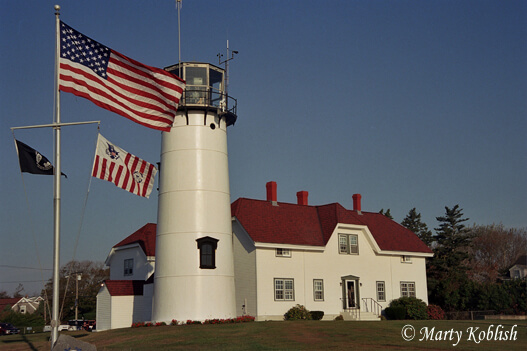
Chatham Lighthouse is an active U.S. Coast Guard light station at the elbow of Cape Cod, and you can visit it three ways: see it for free from the sidewalk or beach year-round, climb the tower on a free guided summer tour, or photograph it from the overlook above Lighthouse Beach. The tower itself sits on a working Coast Guard station, so the grounds open to the public only during scheduled tour times. The light has guided ships past the shoals of Chatham Bar since 1808.
Most visitors come for two different things at once: the practical visit and the history. This guide covers both. You will find what it costs to tour (nothing), where to park (a tight 30-minute lot, so plan ahead), how the lighthouse differs from the beach below it, and the full story of how one station went from twin wooden towers to a single automated beacon. Read on for the visit details first, then the history.
Visiting Chatham Lighthouse: Quick Facts
Here is everything you need before you go, in one place. The lighthouse stands at 37 Main Street, Chatham, Massachusetts, where Main Street meets Shore Road. The grounds are part of an active Coast Guard station, which shapes almost every rule below.
- Cost: Free. There is no paid ticket for the guided tour.
- Tours: Free guided tours run on summer Wednesday afternoons, led by the U.S. Coast Guard Auxiliary. Always confirm the current schedule before you go.
- Grounds: Open to the public only during tour hours. The rest of the year you view the tower from outside the fence.
- Viewing: You can see and photograph the lighthouse from the public sidewalk and the beach every day of the year.
- Parking: Very limited. The closest lot has a 30-minute enforced limit and fills fast in summer.
- Tower climb: 44 steps plus a ladder to the lantern room. Children must be at least 45 inches tall.
- Footwear: Closed-toe shoes recommended. Sandals and flip-flops are discouraged on the steep interior stairs.
- Best time: Mid-morning on a weekday for parking and softer crowds.
Tours, Admission, and the Current Schedule
Chatham Lighthouse tours are free, guided by volunteers, and offered only in the warmer months. The U.S. Coast Guard Auxiliary's Chatham Flotilla 11-1 has served as the volunteer "Keepers of the Light" since 1994, running the public tours and maintaining the property.
Tours typically take place on Wednesday afternoons during summer. For the 2026 season, the Chatham Flotilla scheduled Wednesday tours from late June through late August, roughly 1:00 to 3:00 PM, weather and station operations permitting. Some seasons add alternating Wednesdays into the spring and fall. Because dates shift year to year and tours pause in bad weather, check the official USCG Auxiliary Chatham Flotilla schedule before you drive over.
On the tour, an Auxiliarist walks you through the station's history and the operation of the DCB-224 aerobeacon, then you climb the 44 steps to the lantern room for a view over Chatham Bar. Tour groups also see a decommissioned 36-foot Coast Guard motor lifeboat displayed on the grounds. According to the Auxiliary, more than 90,000 people have toured the inside of the light since public tours began.
A few rules keep the climb safe. Backpacks are not allowed inside the tower and should be left in a secure spot first. Hold the handrails the whole way up, since the interior stairs are steep. Children under 45 inches tall cannot make the climb, and every child needs a parent or responsible adult along.
Parking Near Chatham Lighthouse
Parking is the hardest part of the visit. The closest option is the Lighthouse Overlook lot on Main Street, directly across from the light, which holds about 44 cars and is free for 30 minutes only. That limit is strictly enforced, and in summer the lot turns over constantly.
Thirty minutes is enough to take photos and read the rescue plaque, but not enough to take a full tower tour. If you are touring, your better move is to park in downtown Chatham and walk east along Main Street, or arrive by bike. A short walk from the village center reaches the lighthouse in well under fifteen minutes.
For a longer beach day, the town sells a Chatham beach parking pass, and there is paid parking near Bridge Street that gives you the full day without the 30-minute clock running. You can plan the rest of your day from the lighthouse using the things to do in Chatham hub.
Do You Need Tickets for Chatham Lighthouse?
No. You do not need a ticket, and there is no admission fee for the standard Chatham Lighthouse tour. The confusion usually comes from searches for "Lighthouse Beach tickets," but the beach and the lighthouse charge for different things, and neither sells a tour ticket.
Here is the breakdown:
- The tower tour is free. Access is limited to scheduled tour windows because this is an active Coast Guard station, not because anyone is charging at the door.
- Beach parking can cost money in season through a town parking pass, but that is a parking fee, not a lighthouse fee.
- Viewing the lighthouse from the sidewalk or beach is free and available all year.
So if your plan is to look at the lighthouse, photograph it, or climb it on a tour day, you will not pay an entrance fee. Budget only for parking if you want to stay longer than 30 minutes.
Chatham Lighthouse and Lighthouse Beach: What's the Difference?
People use "Chatham Lighthouse," "Chatham Light," and "Lighthouse Beach" as if they were one place, but they are three connected things. Getting the difference straight saves you a frustrating visit.
- Chatham Lighthouse (also called Chatham Light) is the active light tower and the Coast Guard station around it, on the bluff at 37 Main Street. Public access to the grounds is limited to tour hours.
- Lighthouse Beach is the stretch of shoreline below and east of the bluff, reached by the public stairway down from the overlook. The beach is open; the station above it is not.
- The Lighthouse Overlook is the parking and viewing area across Main Street, where the 30-minute lot and the SS Pendleton rescue plaque sit.
The simplest way to hold it in your head: the lighthouse is the building you tour, the beach is the sand you walk, and the overlook is where you park and read the plaque. If you want a fuller rundown of the area's shoreline, the Chatham beaches guide covers access and conditions across town.
Best Times to Visit and Photograph Chatham Light
The light photographs well from several public vantage points, and the right time of day changes which angle works. You never need to be on the grounds to get a strong shot, which matters since the grounds are closed most of the year.
For the classic front-on view of the white tower with its gray lantern, morning light is best, since the sun comes from the east over the Atlantic and lights the seaward face. Shoot from the sidewalk or the overlook for that one. Later in the day, afternoon light flatters the keeper's house and the station buildings, which face the road.
The beach below the bluff gives you a lower angle with sand and surf in the frame, good for wide shots near sunset, though the tower itself falls into shadow as the light drops behind it.
A few practical notes. The bluff edge is unstable from ongoing erosion, so stay back from the drop. Summer weekends crowd the overlook by late morning, so a weekday or an early arrival gives you cleaner frames and a parking spot. The lighthouse also draws photographers around the winter holidays, when the town decorates it.
Why Chatham Lighthouse Matters
Chatham Light marks one of the most dangerous stretches of the New England coast. It guides mariners past Chatham Bar, the shifting sandbar at the entrance to Chatham Harbor where the Atlantic meets Nantucket Sound. The bar has wrecked ships for centuries, which is exactly why a beacon has burned here without interruption since 1808.
The light is also unusual in that it stays lit 24 hours a day, every day of the year, rather than only after dark. Its modern beacon throws a beam visible far out to sea, and the station it sits on still runs active search-and-rescue missions for the local fishing fleet and recreational boaters. This is a working safety installation, not a retired monument, which is why the Coast Guard limits public access to the grounds.
History of Chatham Light
The station you see today is the product of more than two centuries of rebuilding, relocation, and upgrades, driven mostly by erosion and improving technology. The history below moves in order, from the original twin towers to the automated beacon now in the lantern room.
The Original Twin Lights, 1808
Chatham Lighthouse was established in 1808 as the second light station built on Cape Cod. To tell it apart from Highland Light up the coast at North Truro, the government built it as two separate towers standing about 70 feet apart, which is why mariners called it the "Twin Lights."
Sailors offshore could count the pair and know exactly which point of land they were passing. The original 1808 towers were wooden and stood well east of the current site, more than 200 feet back from a 50-foot bluff that has since washed away.
Rebuilding After Erosion: 1841, 1857, and 1877
Erosion shaped every chapter of this station. The wooden towers were replaced with new construction in 1841. In 1857, both towers received fourth-order Fresnel lenses, a major advance that focused the flame into a far stronger beam reaching much farther out to sea. A storm in November 1870 broke through the outer sandbar and accelerated the cliff loss.
Local histories record that the towers once stood more than 200 feet back from the bluff but were within roughly 50 feet of the edge by the mid-1870s. In 1877 the station was rebuilt again, this time with cast-iron towers lined with brick, set safely back on the present site. One of those cast-iron towers is the lighthouse standing today.
How One Chatham Tower Became Nauset Light
By the early 1920s, rotating-beacon technology made two towers unnecessary. A single rotating light could flash a recognizable pattern that distinguished one station from another, so a station no longer needed a matched pair. In 1923 the towers were separated.
One stayed in Chatham; the other was moved north to Eastham, where it was repainted and became Nauset Light, replacing the last of Eastham's worn-out "Three Sisters" towers. After 1923, Chatham operated as a single light.
Electrification, Automation, and the Modern Beacon
The remaining Chatham tower kept modernizing. Electric power replaced kerosene lanterns in 1939. In 1969 a Carlisle and Finch rotating optic replaced the 1857 Fresnel lens, and the old lantern room came down; local accounts put the new optic at roughly 2.8 million candlepower.
Full automation arrived in 1982, ending the era of resident keepers after the station had been staffed continuously since 1808. In August 1993, the Carlisle and Finch system gave way to the DCB-224 aerobeacon, the unit operating now. It produces the Fl(2) 10s flash pattern charted on navigation publications, with a nominal range of about 24 nautical miles.
Chatham Bar, Shipwrecks, and the SS Pendleton Rescue
The most famous event tied to this station happened just offshore in February 1952. During a violent nor'easter, the T-2 oil tanker SS Pendleton split in two off the Chatham coast. A four-man Coast Guard crew launched in a 36-foot wooden motor lifeboat, the CG36500, crossed Chatham Bar in near-zero visibility and enormous seas, and pulled 32 survivors off the tanker's sinking stern section.
They steered home in the dark after losing their compass overboard. All four crew members received the Coast Guard Gold Lifesaving Medal, the service's highest honor for saving lives at sea, and the Coast Guard has called the mission the "Mount Everest" of small-boat rescues.
The 2016 film The Finest Hours, filmed partly in Chatham in 2014, dramatized the rescue. A plaque at the Lighthouse Overlook, across from the light, tells the story on-site. The station grounds display a decommissioned 36-foot motor lifeboat of the same type used in the rescue, but the actual rescue boat, the CG-36500, is preserved separately at Rock Harbor in Orleans by the local historical society. The wreck is one of many along this coast; the broader story of Cape Cod shipwrecks shows why Chatham Bar earned its reputation.
Where to See the Original Fresnel Lens
The 1857 fourth-order Fresnel lens that once topped the Chatham tower did not disappear when the station modernized. When the old lantern room was removed in 1969, the lens and its housing were donated to the Chatham Historical Society and installed at the Atwood House Museum on Stage Harbor Road, about 1.2 miles from the lighthouse. It remains there today and is illuminated during all open hours, generally mid-June through mid-October.
This makes the museum the natural second stop on a lighthouse visit. You can stand under the actual lens that guided ships off Chatham for over a century and examine the prism rings up close, something you cannot do inside the active tower. The restored lantern room still holds its original Fresnel lens, which the museum keeps illuminated during open hours.
Nearby Things to Do After Visiting
The lighthouse fits naturally into a half-day or full day in Chatham, since several worthwhile stops sit within a short drive or walk.
- Downtown Chatham: Walk west on Main Street from the lighthouse into the village for shops, food, and the easiest place to park. The downtown Chatham guide maps it out.
- Shore Road scenic drive: The lighthouse sits right on this coastal route; the Shore Road scenic drive strings together the best water views in town.
- Atwood House Museum: Home of the original Fresnel lens and the town's deeper maritime collection.
- Monomoy National Wildlife Refuge: A barrier-island refuge south of town for birds, seals, and quiet beaches. See the Monomoy National Wildlife Refuge guide for access.
- More to plan: If you are building a full itinerary, the top things to do in Chatham roundup pulls it together.